What Nutrition Actually Does to Cognitive Performance on Long Voyages

By Gilly Kinsky, VP of Marketing at Agwa
A senior fleet manager at one of Agwa's customers noticed something unexpected after the Agwa cabinet was installed on two of his vessels. Crew members were spending time near it between watches, not tending to it, just standing near it.
"Many of the crew told me they spend some time after their watches near the Agwa cabinet, to see the greenery and watch plants grow," he wrote. "It gives them mental peace in the mid-ocean."
It's a small observation. But it points at something the maritime industry has been slow to take seriously: the relationship between what crews eat, how they feel, and how well they perform in safety-critical roles.
The gap nobody talks about
On most vessels, fresh greens are exhausted within 5 to 7 days of departure. After that, crews rely on frozen and preserved ingredients for the remainder of the voyage. On long transoceanic routes, that can mean weeks without fresh produce.
This is a known, accepted part of shipboard life. It tends to get filed under "catering" and managed accordingly, with catering budgets, provisioning schedules and menu planning. What it rarely gets filed under is risk management.
Let’s reconsider that framing.

What the nutrition research actually shows
There is no large randomised trial conducted on seafarers linking diet quality to bridge errors. But the underlying science is well-established and applies directly to any occupation that requires sustained attention, fast reaction times and sound decision-making under pressure.
Large reviews of diet and cognitive health consistently show that diets rich in fresh vegetables, fruits, whole grains and healthy fats are associated with better attention, memory and executive function. Micronutrients, particularly B-vitamins, iron and polyphenols, play specific roles in supporting the neural processes behind alertness and cognitive control. Conversely, diets high in processed food and low in nutrients increase systemic inflammation and oxidative stress, both of which are linked to impaired concentration and slower processing speed. A 2009 position paper in cognitive neuroscience stated that "numerous studies have shown that many aspects of cognition are affected by nutrition, including memory, attention-deficit, depression and dementia."
A comprehensive 2023 review, "Nutrition and cognitive health: A life course approach," put it plainly: higher intake of healthy whole foods is one of the most consistent levers available for reducing cognitive decline and supporting brain performance over time.
That's the first link in the chain. A crew eating frozen and preserved food for two weeks straight is not eating the diet that supports optimal cognitive performance. The deficit is not dramatic on any given day. But it accumulates.
The fatigue compounding effect
The nutrition-cognition link gets more complicated at sea because of how shift schedules interact with diet.
Research on circadian disruption and social jetlag shows that people working irregular sleep patterns tend toward higher intake of sugar and energy-dense foods, and lower intake of fruit and vegetables. Disrupted sleep degrades appetite regulation, which in turn shifts food preferences toward processed, high-energy options. The result is a self-reinforcing cycle: poor sleep degrades diet quality, and poor diet quality degrades the body's ability to manage fatigue.
Seafarers running 6-on/6-off watch schedules are living this cycle. The watchkeeping schedule that most vessels rely on is, by sleep science standards, one of the least compatible with sustained cognitive performance. Project Horizon, a European Commission multi-partner research project on fatigue at sea, found that common watch systems are associated with increased sleepiness and measurably degraded performance in full-mission bridge simulations, including slower reaction times and higher error rates.
Add chronically low fresh vegetable intake to an already strained sleep architecture, and you have a compounding effect that is greater than either factor alone.
Where this meets safety
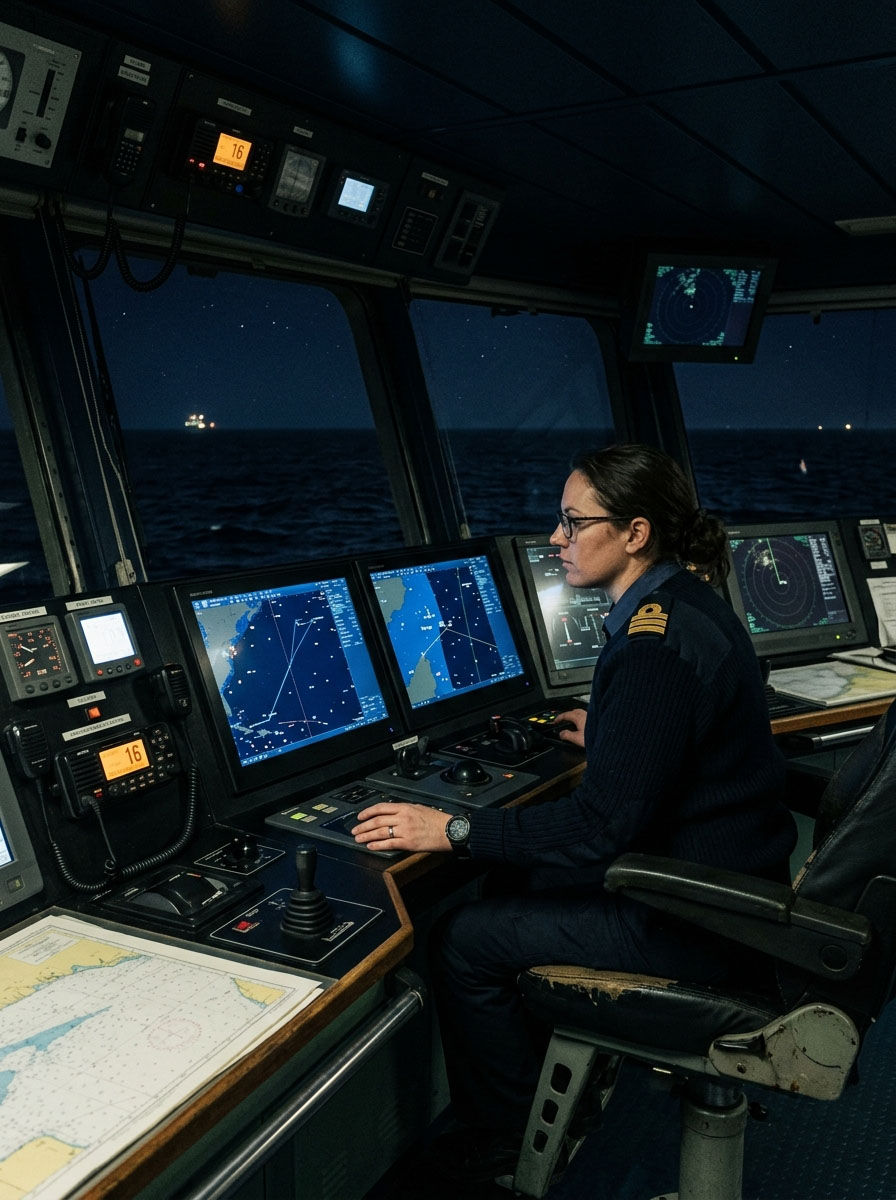
The maritime fatigue literature is specific and well-documented. Research from the Cardiff Seafarers' Fatigue programme, the MAIB's Bridge Watchkeeping Safety Study (2004), and the ITF all point to similar figures: fatigue is implicated in up to 23 percent of collisions, groundings and serious marine incidents. The MAIB's analysis of 66 collisions and near-collisions between 1994 and 2003 explicitly linked fatigue risk to common watchkeeping patterns and undermanned bridge teams. Allen, Wadsworth & Smith's review of seafarer fatigue (International Maritime Health, 2008) also summarises experimental work showing that sleep loss degrades the cognitive and perceptual skills most critical to navigation, including reaction time and decision-making, within 30 to 36 hours of deprivation.
Nutrition does not cause fatigue in the way that a 6-on/6-off watch schedule does. But it is a modifiable factor within the same risk system. A crew member eating well and consuming sufficient micronutrients is more resilient to the cognitive effects of fatigue than one subsisting on frozen and preserved food for the back half of a voyage.

A structural problem with a structural solution
The freshness gap tends to be discussed as a provisioning inconvenience. Fresh vegetables are expensive to store, quick to spoil, and difficult to source consistently across global routes. Operators have adapted by accepting dependence on frozen and preserved alternatives from around day 5 to 7 onwards.
Viewed through a nutrition lens, that adaptation has a cognitive cost that runs the length of the voyage. Industry commentary on onboard food production links access to fresh produce directly with better focus, alertness and decision-making, and fewer stress-related errors at sea. An industry survey found that nearly all seafarers, 98.8 percent, say a healthy diet is important to their wellbeing. The gap between what crews want, what the evidence supports, and what they actually have access to on long voyages is real and worth taking seriously as an operational matter, not just a catering one.
The crew member standing near the Agwa cabinet between watches, finding something like calm in the presence of green, growing things in the middle of the ocean, may be onto something the industry is still catching up to.
Agwa enables vessels to grow fresh vegetables continuously onboard, with no agricultural knowledge required. Learn more at agwafarm.com.


